
Revenue Cycle Management Built Around Better Workflows.
Lumina manages the full revenue cycle — billing, active AR management, denial prevention and resolution, credentialing, workflow optimization, and financial intelligence — for hospitalist and post-acute physician groups.
Core Services
Revenue Cycle & Credentialing
The foundation of every high-performing medical group — billing designed to protect collectible revenue, and credentialing designed to reduce avoidable reimbursement delays.
Hospitalist Billing
Inpatient billing designed to protect collectible revenue for your physicians.
Hospital medicine billing is high-volume, documentation-intensive, and unforgiving. A missed charge, a miscoded E&M level, or a slow denial response directly erodes your group's revenue. Lumina actively manages the full billing cycle — from charge capture through AR follow-up, denial resolution, and payment reconciliation. We don't submit claims and wait. Outstanding receivables are monitored, unpaid claims are investigated, and accounts are worked through resolution by experienced staff.
What We Handle
- Daily charge capture and reconciliation
- E&M level optimization and coding review
- Electronic claim submission and tracking
- Denial management and appeals
- Payment posting and ERA reconciliation
- Patient responsibility billing
- Monthly revenue reporting
Ideal for: Hospitalist groups of all sizes — from single-hospital programs to large multi-site enterprises serving high patient volumes annually.
Get StartedSNF & Post-Acute Physician Billing
The payer complexity of SNF and post-acute physician billing — handled with precision.
Post-acute physician billing presents three specific challenges that create revenue risk for physician groups: the EHR workflow gap (PointClickCare, MatrixCare, and Vision often do not connect directly to a physician group's charge-capture and practice-management stack without an interface, export process, or structured workflow — an often-overlooked source of revenue-cycle complexity), the Medicare plan complexity (straight Medicare, Medicare Advantage, and Medicare/Medicaid hybrids each have distinct billing requirements), and the high-volume compounding effect (at rounding-group volume, even a small clean claim rate problem creates an outsized denial backlog). Lumina's team has deep experience in post-acute settings — we know these issues and how to manage them.
What We Handle
- PointClickCare, MatrixCare & Vision EHR data extraction
- Medicare Part B and Medicare Advantage billing
- Medicare/Medicaid hybrid plan requirements
- SNF visit frequency and documentation compliance
- Subsequent hospital care and discharge day coding
- Advance Care Planning (ACP) billing
- Denial management specific to post-acute payers
Ideal for: Physician-led SNF rounding practices — daily rounding across multiple facilities, complex payer mix, and high documentation volume.
Get StartedCredentialing & Enrollment
Proper enrollment and credentialing are critical to provider revenue readiness and collectible reimbursement.
Credentialing and payer enrollment are prerequisites for revenue — not administrative formalities. Credentialing delays can delay reimbursement and place otherwise collectible revenue at risk. For groups expanding to new facilities or adding providers, credentialing bottlenecks are one of the most common and most preventable sources of revenue delay. Lumina manages the entire credentialing lifecycle through a purpose-built credentialing web module — designed to organize the process around clear tasks, ownership, status, documentation, and deadlines. Clients have structured visibility into where every provider stands at any time.
What We Handle
- Initial payer enrollment for new physicians
- Re-credentialing and re-enrollment management
- CAQH profile setup and maintenance
- Medicare and Medicaid enrollment
- Medicare Advantage plan enrollment
- Facility privileging coordination
- Expiration date tracking and proactive renewal
- Credentialing document collection and storage
Ideal for: Growing groups adding physicians or expanding to new SNF and hospital facilities — where credentialing delays directly delay revenue.
Get StartedInside the Credentialing Operations Workspace
Credentialing is one example of Lumina's workflow-first operating model. We defined the process first, then built the infrastructure needed to organize provider requirements, payer enrollment, facility participation, expirations, tasks, documentation, and status visibility.
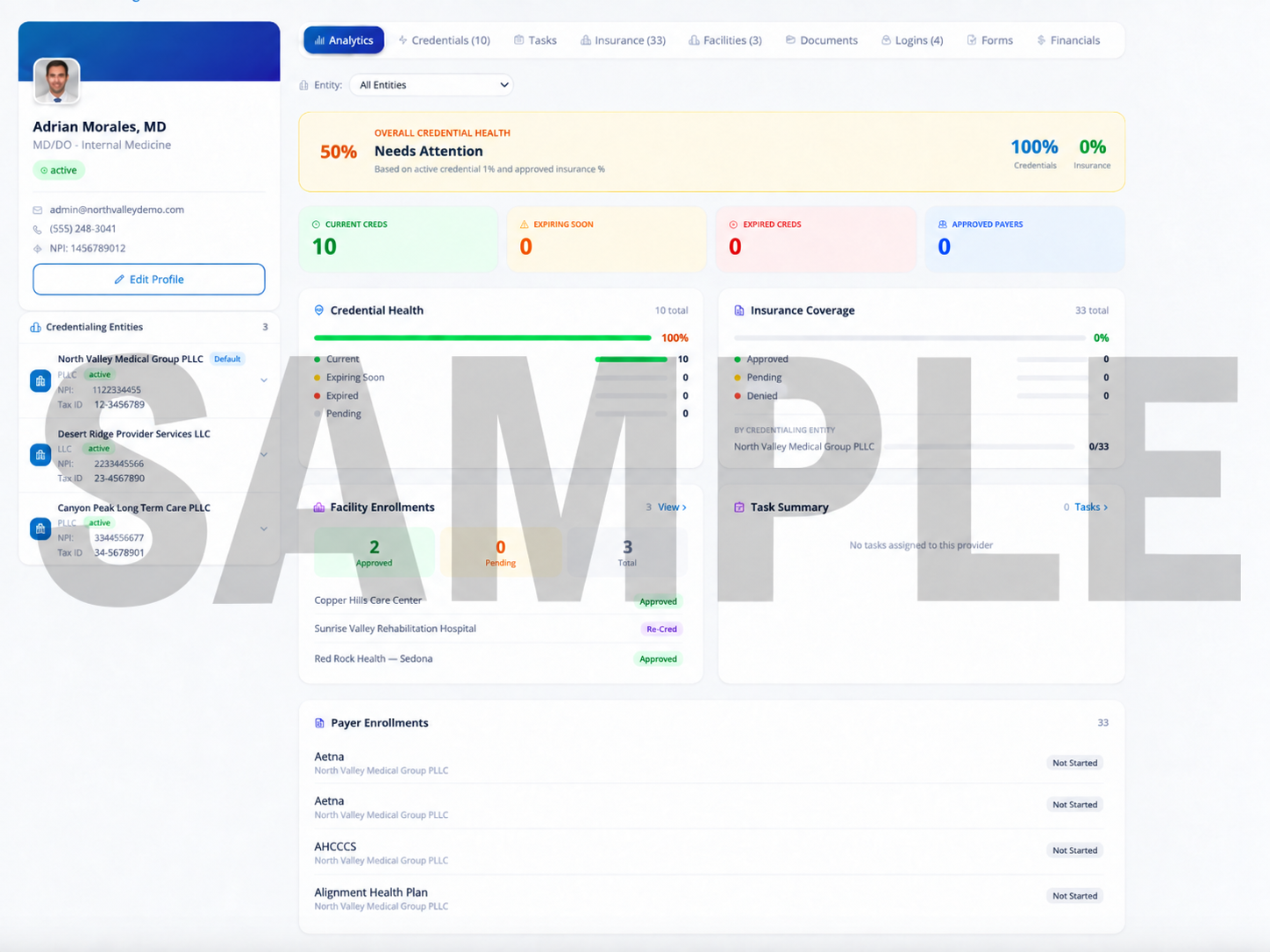
Purpose-built infrastructure supporting Lumina's managed credentialing service.
Sample interface shown with fictitious data.
Better Revenue-Cycle Performance Starts With a Better Process.
Lumina looks beyond individual claims to evaluate how information, responsibilities, decisions, and payer requirements move through the entire revenue cycle — then improves the workflow around the correct strategy.
Revenue problems often begin before the claim is submitted. Documentation handoffs, charge capture gaps, insurance data errors, eligibility issues, credentialing gaps, and disconnected systems can all create downstream denials and delayed payments. Lumina's approach is to improve the process upstream rather than only reacting after a claim denies or ages.
The Three-System Revenue Pipeline
Facility EHR
PointClickCare · MatrixCare · Vision
RoleSource of truth for patient demographics, visit records, and clinical documentation
Facility EHRs often do not connect directly to a physician group's existing charge-capture and practice-management stack without an interface, export process, configured integration, or structured workflow — an often-overlooked source of revenue-cycle complexity in post-acute physician billing
We work directly with your facility EHR to extract and organize clinical data, validate it against your rounding schedule, and flag discrepancies before a claim is submitted
Charge Capture
Mobile rounding apps · Paper superbills · EHR-embedded tools
RoleRecords what each physician did, when, and for which patient — the raw input for every claim
Charge capture tools vary widely across groups and facilities. Incomplete captures, duplicate entries, and timing mismatches between rounding and billing create revenue leakage that compounds at high volume
We audit your current charge capture process, identify where charges are being missed or delayed, and configure your tools to align with your rounding patterns — then reconcile daily against the facility census
Practice Management
Kareo · AdvancedMD · Athenahealth · DrChrono
RoleThe billing engine — where claims are built, submitted, tracked, and reconciled against payments
Without clean, structured input from the EHR and charge capture layers, the practice management system produces dirty claims — wrong patient data, missing modifiers, incorrect payer routing — that result in denials and delayed revenue
We configure your PM platform for your specific payer mix (Medicare Part B, MA plans, Medicaid hybrids, commercial), set up ERA reconciliation, and build the reporting layer that gives your leadership real-time visibility into revenue performance
Lumina does not simply recommend better workflows. We operate them. Workflow optimization is built into how we manage the revenue cycle — not sold as a separate consulting service.
Our Analysis Process
Current-State Workflow Review
We map every data handoff in your practice — from rounding to charge capture to claim submission — and identify exactly where manual steps, disconnected systems, or process gaps are creating revenue risk.
Strategy and Process Design
Before improving a workflow, the underlying strategy has to be correct. We evaluate care setting, payer requirements, billing rules, credentialing needs, and operational priorities before designing the process around them.
Workflow and Systems Improvement
We improve ownership, handoffs, review processes, escalation paths, and internal controls — and build or configure better operational systems where the workflow requires them.
Execution and Continuous Improvement
Lumina's team actively manages the resulting workflow. Denials, payer delays, aging trends, and operational bottlenecks are reviewed to refine processes and address recurring problems upstream.
Practice Operations
Beyond Billing
The financial and operational infrastructure that lets your leadership team run a high-performing practice — not just a billing operation.
Practice Financial Intelligence
Better workflows require better visibility. Lumina connects revenue-cycle execution with reporting that helps leadership understand where revenue is performing, slowing, or leaking. Provider-level revenue performance, collections, payer trends, AR analysis, and practice profitability reporting give leadership the financial visibility to make informed operational decisions.
- Provider-level revenue and collections reporting
- Payer performance and reimbursement analysis
- Month-over-month revenue trend reporting
- Revenue-cycle KPI dashboards
- AR trend and aging analysis
- Executive financial summary reports
Denial Prevention & Resolution
Lumina works to prevent avoidable denials by strengthening upstream workflows — eligibility review, coverage verification, claim preparation controls, and documentation handoffs. When denials occur, our team reviews the payer response, identifies the root cause, corrects claim problems, submits appeals, and tracks recurring patterns that may require a workflow change.
- Upstream workflow controls to reduce avoidable denials
- Eligibility and coverage verification integrated into billing workflow
- Denial review and root-cause analysis
- Corrected claims and appeals management
- Payer follow-up and escalation
- Recurring denial trend analysis and upstream improvement
Coding & Compliance Auditing
Proactive coding and compliance audits protect your revenue and reduce regulatory risk. Our team reviews documentation, coding accuracy, and billing patterns to identify both compliance gaps and missed revenue opportunities — before a payer does.
- E&M coding accuracy audits
- Documentation compliance review
- Payer-specific billing audits
- Overpayment identification and correction
- Pre-bill audit programs
- Compliance risk assessment
Operational Systems & Workflow Support
When a workflow is difficult to manage with disconnected spreadsheets, manual tracking, or fragmented systems, Lumina looks for a better way to organize the process. Our operational systems are designed around the workflow — not the other way around. We do not add technology for the sake of technology. We build better systems when a better system improves the workflow.
- EHR-to-billing workflow design (PointClickCare, MatrixCare, Vision)
- Charge capture process review and improvement
- Practice management software configuration
- Workflow gap analysis and process improvement
- Internal validation and quality-control processes
- Ongoing monitoring and issue resolution
Not Sure Where to Start?
Most groups begin with a revenue cycle assessment. We'll identify exactly where revenue is leaking and what it would take to fix it.
No commitment. No sales pressure. Just a clear picture of your revenue cycle.