
Better Revenue Cycles Start With Better Workflows.
Lumina combines specialty revenue-cycle expertise, active accounts receivable management, workflow optimization, denial prevention, credentialing, and financial intelligence for hospitalist and post-acute physician groups.
Performance Targets
The Numbers We Work Toward
These are Lumina's performance targets — informed by published MGMA DataDive, Coronis Health, and HFMA national revenue-cycle benchmarking data.
Performance targets. Targets may vary based on payer mix, specialty, documentation, eligibility, credentialing, client workflow, and other operational factors.
What We Do
Revenue Cycle Management — End to End
From charge capture to credentialing to financial reporting — purpose-built for hospitalist and post-acute physician groups.
Hospitalist Billing
Specialized revenue cycle management for hospital medicine groups — charge capture, E&M coding, claim submission, accounts receivable management, denial resolution, and payment posting. We understand the complexity of inpatient billing and actively work every account through reimbursement and resolution.
- First-pass clean claim rate above industry benchmarks
- Active AR follow-up — not passive claim submission
- Denial prevention through upstream workflow controls
SNF & Post-Acute Physician Billing
Purpose-built billing for physician groups rounding at Skilled Nursing Facilities, sub-acute rehab, and Long-Term Care. We handle the complex payer mix — Medicare Part B, Medicare Advantage, Medicaid, and commercial — with the precision daily rounding practices demand.
- SNF, LTC, and sub-acute specialty expertise
- Medicare and Medicare Advantage payer requirements handled
- Structured EHR workflow support across PointClickCare, MatrixCare, and Vision
Active AR Management
Lumina does not submit claims and wait. Outstanding receivables are monitored, unpaid and underpaid claims are investigated, payer activity is followed, and accounts are worked through resolution.
DetailsDenial Prevention & Resolution
Upstream workflow controls are designed to reduce avoidable denials. When denials occur, our team reviews the payer response, identifies the root cause, corrects claim problems, submits appeals, and tracks recurring patterns.
DetailsCredentialing & Revenue Readiness
Credentialing and enrollment directly affect revenue readiness. Lumina connects provider credentialing workflows with the broader revenue cycle so enrollment gaps, licensing issues, and payer requirements are identified and addressed before they delay revenue.
DetailsPractice Financial Intelligence
Provider-level revenue performance, collections, payer trends, AR analysis, and practice profitability reporting — giving leadership the financial visibility to understand where revenue is performing, slowing, or leaking.
DetailsRevenue Cycle Workflow Optimization
Lumina evaluates how information, responsibilities, decisions, and payer requirements move through the entire revenue cycle — identifying weak handoffs, missing controls, disconnected systems, and recurring denial causes, then improving the workflow around the correct strategy.
DetailsHow We Work
Strategy. Workflow. Systems. Execution.
Better revenue-cycle performance starts with a better process. Lumina does not optimize a bad workflow — we evaluate the underlying strategy first, then design the process around it.
Get the process right first.
Before improving a workflow, the underlying strategy has to be correct. We evaluate care setting, payer requirements, billing rules, credentialing needs, physician-group structure, and financial objectives before designing the process around them.
Design how the work should move.
We improve ownership, handoffs, review processes, escalation paths, prioritization, consistency, and internal controls — so the revenue cycle operates with clarity and accountability at every step.
Build better infrastructure around the workflow.
When a workflow is difficult to manage with disconnected spreadsheets or fragmented processes, Lumina builds or uses better operational systems — designed around the workflow, not the other way around.
Actively manage the work.
Lumina's team performs medical billing, AR follow-up, payer follow-up, denial resolution, appeals, credentialing, enrollment, payment review, and reporting — and uses the results to improve the process upstream.
Better strategy. Better workflows. Better systems. Better execution.
Practice Infrastructure
Purpose-Built Infrastructure for Better Practice Operations.
When the workflow needs a better system, we build it.
Lumina does not add technology for the sake of technology. We first determine how the operation should work, design the workflow around the correct strategy, and then build or configure the infrastructure needed to support it.
Our credentialing workspace is one example — bringing provider readiness, credentials, payer enrollment, facility enrollment, expirations, tasks, documentation, entity relationships, and operational visibility into one structured environment.
The system supports our team and gives clients greater visibility into the work. It does not replace the hands-on credentialing, enrollment, follow-up, and revenue-cycle execution our team performs.
Provider Readiness
See credential status, expirations, enrollment progress, and outstanding requirements in one operational view.
Enrollment Visibility
Track payer and facility enrollment status without relying on disconnected spreadsheets, emails, and manual status updates.
Operational Oversight
Give leadership and the Lumina team clearer visibility into tasks, requirements, provider status, and workflow bottlenecks.
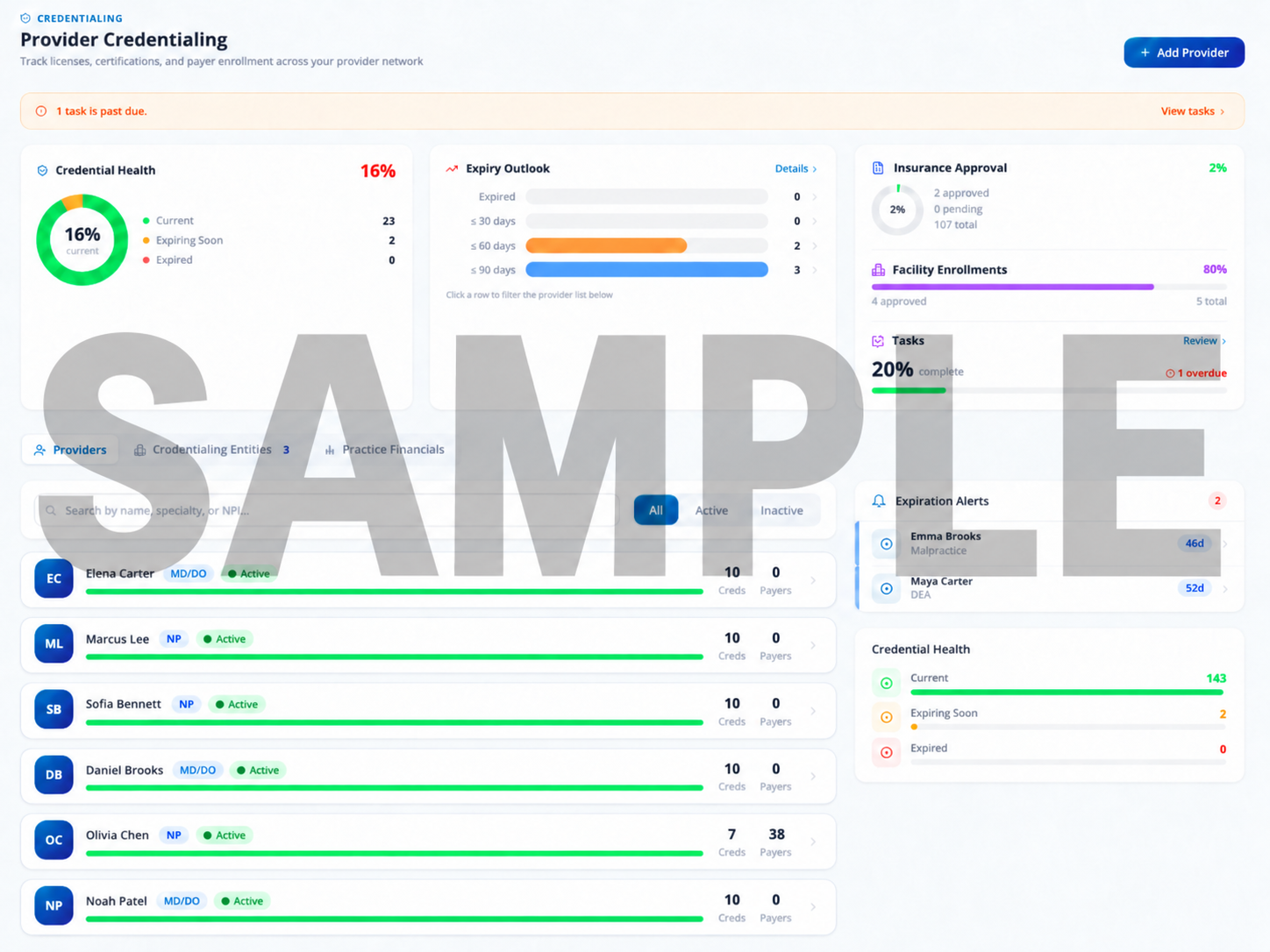
Practice-Level Credentialing Oversight
A centralized view of provider credential health, expirations, enrollment progress, tasks, alerts, and readiness.
Sample interface shown with fictitious data.
Provider-Level Operational Visibility
Move from practice-level oversight into individual provider details — credentials, payer enrollment, facility participation, tasks, documents, entities, and operational status in one workspace.
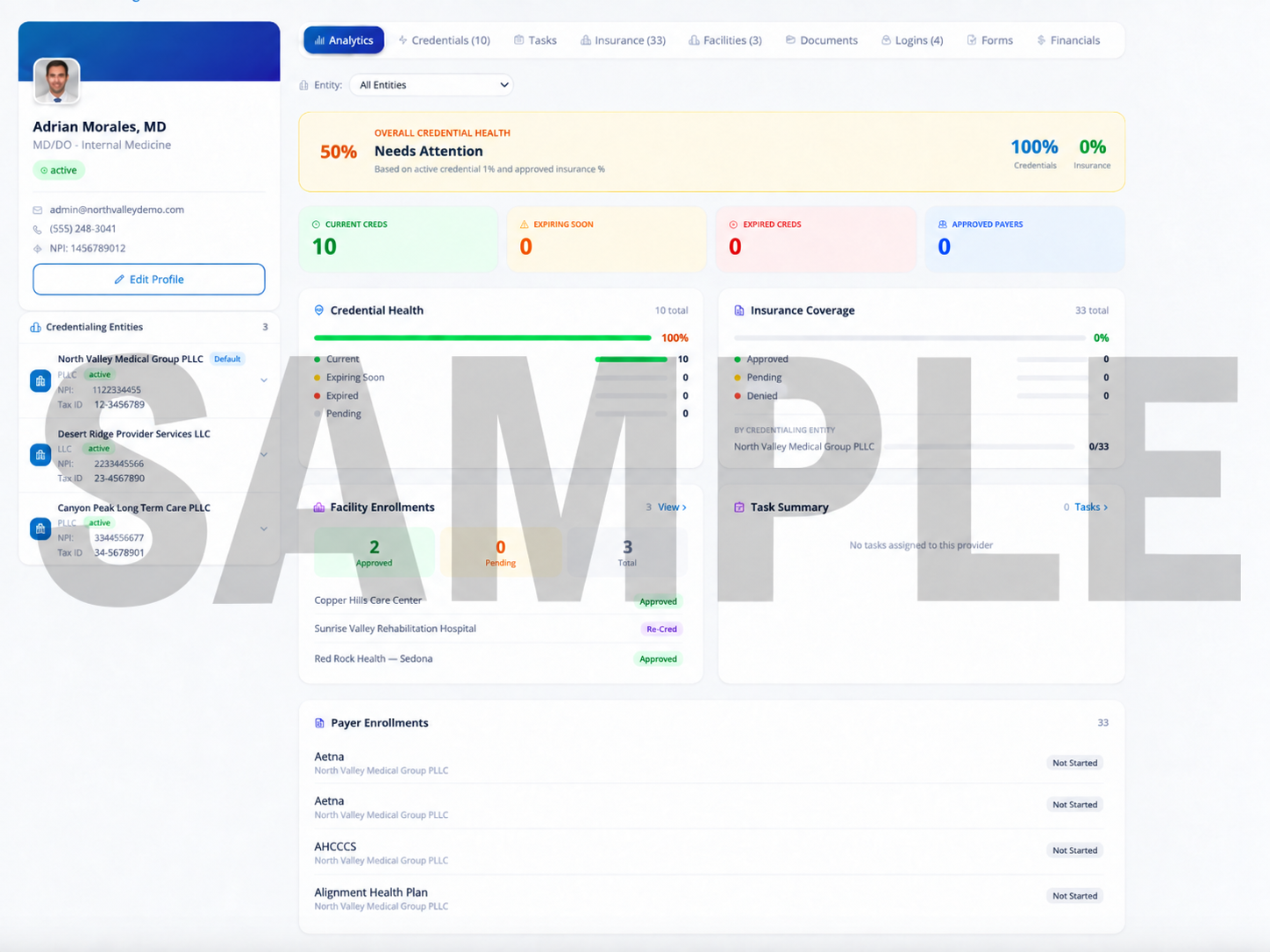
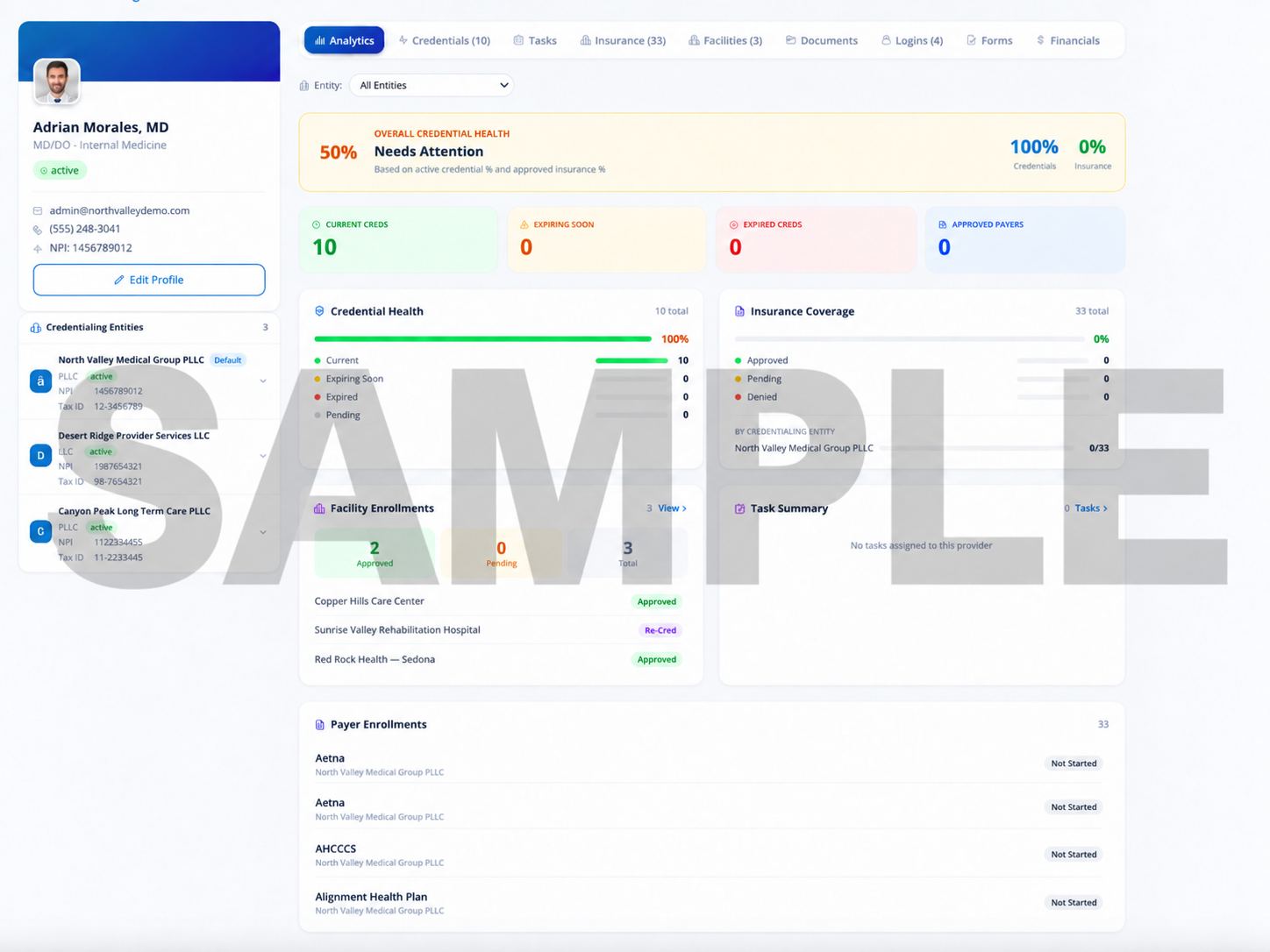
Sample interfaces shown with fictitious data.
Active Accounts Receivable Management
Lumina Does Not Submit Claims and Wait.
Submitting a claim is only one step in the revenue cycle. Lumina actively monitors outstanding receivables, investigates unpaid and underpaid claims, follows payer activity, resolves claim obstacles, and works accounts through resolution.
Why Lumina
Built Around Real Revenue-Cycle Problems.
Lumina was built around the operational challenges physician groups face every day — fragmented workflows, payer complexity, credentialing delays, aging receivables, denials, disconnected systems, and limited financial visibility. Our approach is to understand the underlying problem first, determine the correct strategy, improve the workflow, build better systems where needed, and actively manage the resulting process.
Preventing avoidable denials. Resolving the ones that occur.
Denials, payer delays, credentialing issues, disconnected workflows, and aged receivables can all create avoidable revenue-cycle friction. Lumina addresses both the upstream process and the downstream resolution work — strengthening workflows to reduce preventable denials, and actively resolving the ones that occur.
Ready to Strengthen Your Revenue Cycle?
Request a revenue cycle assessment and see where your group stands — AR performance, denial patterns, credentialing exposure, workflow gaps, and where improvement is possible.